


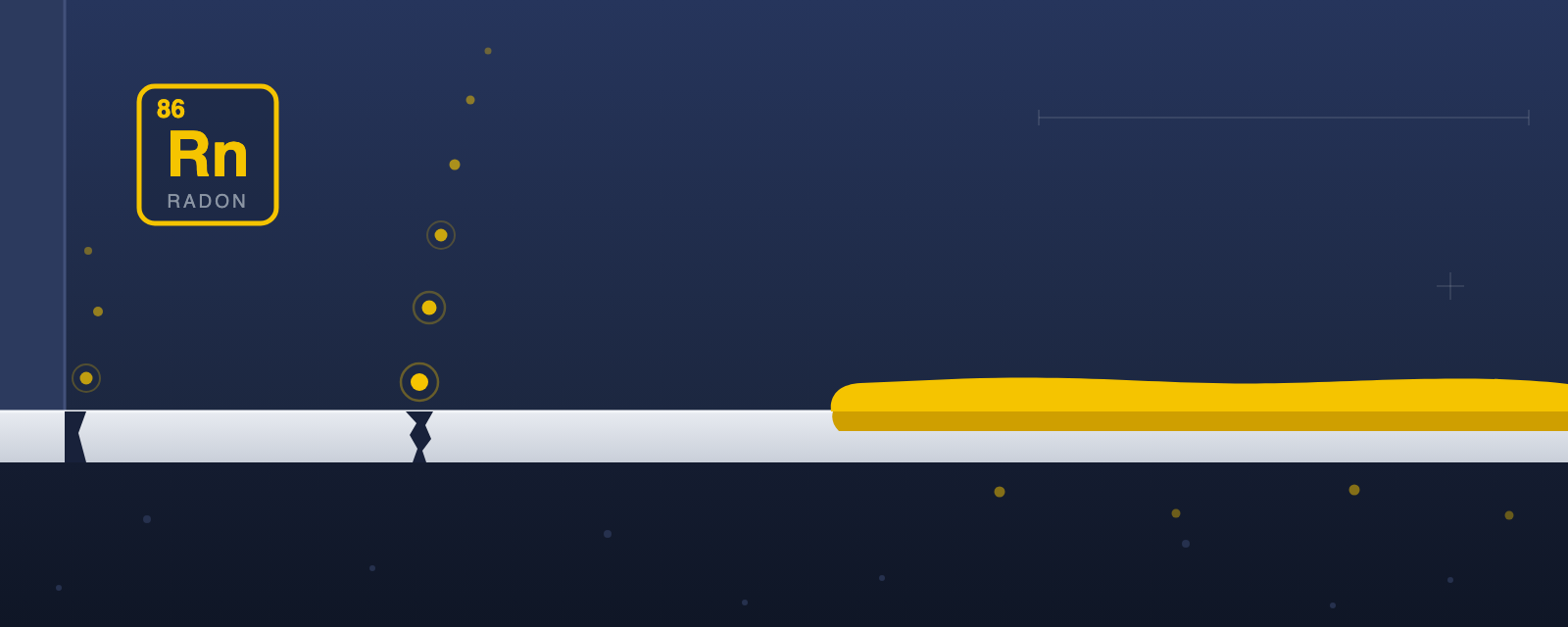
Radon is a radioactive gas (invisible, odourless) that rises from the ground and seeps into virtually every building in Canada. Most of the time, concentrations stay low. But roughly one home in ten exceeds Health Canada's recommended threshold, and the only way to know is a test that costs about fifty dollars. Here is how radon gets into your home, how to measure it without being sold anything, and what actually works to block it.
What Is Radon, and Why Should You Care?
Radon comes from the natural breakdown of uranium in soil and rock. Outdoors, it dilutes into the air and poses no risk. The problem starts when it seeps into an enclosed space, your basement, and builds up all winter with the windows closed.
Health Canada's numbers are blunt: radon is the second leading cause of lung cancer in the country, after smoking, and the first among non-smokers. It is linked to roughly 3,000 deaths per year in Canada. This is not an exotic threat: it is a documented, measurable risk, and one that costs less to fix than most renovations.
No region of Quebec is "safe" by default. Concentration depends on the geology under your lot, your foundation type and how the house ventilates. Two neighbouring homes can test completely differently. That is why no map replaces an actual test.
How Does Radon Get Into a House?
From below, by suction. In winter, warm air rising through the house creates a slight negative pressure in the basement: the stack effect. That pressure literally pulls soil gas in through every available opening:
- cracks in the concrete slab, even hairline ones;
- the joint between the slab and the foundation walls, a full perimeter, rarely sealed;
- openings around plumbing and drains that pass through the slab;
- the sump pit, when the basin has no airtight lid;
- a dirt-floor crawl space, the worst case: no barrier at all between the soil and the house.
A counter-intuitive detail: newer homes are not exempt. The more airtight a house is, the less its air turns over, and the more concentrated any radon that enters becomes. A basement finished into living space (bedroom, office, playroom) deserves a test all the more: that is where you and your kids actually breathe.
How to Test for Radon, Without Getting Played
A long-term dosimeter, one heating season, about $50. That is it. No specialized firm, no $300 connected gadget needed for a first diagnosis.
The method Health Canada recognizes: a detector placed at the lowest level where you spend time, for at least 3 months, ideally October through April. Short tests of a few days swing too much to conclude anything, radon levels fluctuate with weather, ventilation and season. Certified dosimeters are sold in many hardware stores and through lung-health organizations; the price includes the lab analysis.
Once you have your result, the official guidance is simple:
| Test result | What Health Canada recommends |
|---|---|
| Below 200 Bq/m³ | No remediation required. Retest after major renovations or if you finish the basement. |
| 200 to 600 Bq/m³ | Fix the situation within 2 years. |
| Above 600 Bq/m³ | Fix it within 1 year. At those levels, you do not wait. |
The Canadian guideline is 200 becquerels per cubic metre (Bq/m³). The World Health Organization suggests aiming even lower, 100 Bq/m³, because the risk has no magic threshold: the less, the better. Full official details are on Health Canada's radon page.
What Are the Options if Your Level Is High?
We will be frank, as usual: if your test comes back well above the guideline, the recognized fix is a sub-slab depressurization system, installed by a contractor certified in radon mitigation (C-NRPP certification). A pipe goes through the slab, a fan draws the air from under the foundation and vents it outside before it ever gets in. Expect $2,000 to $3,500, for a reduction that often reaches 80 to 90% of the level. It is the right tool for a real problem, and it is not something we install.
But depressurization works even better, and far less radon enters in the first place, when the basement envelope is airtight. That is where our trade meets your problem.
Spray Foam Sealing: The First Line of Defence
Health Canada recommends sealing radon entry points as a baseline measure: slab cracks, the slab-to-foundation joint, plumbing penetrations. That is exactly what spray polyurethane foam does, and it is work we already do every week in basements and crawl spaces.
Spray foam forms a continuous membrane bonded to the surface: no joints, no seams, no tape peeling off in five years. Applied to the base of the foundation walls, the rim joist and the slab perimeter, or over the floor of a dirt crawl space, it cuts the air paths between the soil and the house. And since it is first and foremost an insulator (R-6 per inch), the same job cuts your heat loss: radon sealing and heating savings are two sides of the same work.
Let us be precise about what it does and does not do:
- What sealing does: it reduces radon entry points, improves the efficiency of any mitigation system, and insulates and blocks ground moisture at the same time. For a dirt-floor crawl space, it is the baseline fix, radon or not.
- What it does not do: guarantee on its own that you will get below 200 Bq/m³ if your level is very high. No serious contractor will promise that. The honest sequence: test, seal, retest, and if the level stays high, have a certified mitigator install depressurization. The two measures complement each other.
What Does It All Cost?
Here are the real Quebec market ranges, so you can plan without surprises:
| Measure | Typical price | When |
|---|---|---|
| Long-term dosimeter (lab analysis included) | $40 to $70 | Now: it is step zero |
| Spray foam sealing and insulation (rim joist, foundation, crawl space) | Depends on the area: online estimate in 2 minutes | Moderate level, dirt crawl space, or a basement you are insulating anyway |
| C-NRPP certified depressurization system | $2,000 to $3,500 | High level confirmed by a long-term test |
The most common scenario is also the best value: you insulate your basement or crawl space for comfort and heating costs, and the radon sealing comes with it, at no extra charge. A $50 test before and after gives you the straight answer, in black and white.
A basement or crawl space to seal?
Get a clear spray foam estimate in minutes, no visit, no pressure. Sealing radon entry points is part of the job.
Get my estimate →