


The short answer
In Quebec, home insulation standards come from the Quebec Construction Code, Chapter I – Building (based on the National Building Code 2015, as amended for Quebec), and more specifically from its Part 11 – Energy Efficiency. For a roof or attic, new construction must reach a thermal resistance of about RSI 7.22 (R-41) in southern Quebec (Montreal, Quebec City, Sherbrooke, Gatineau) and about RSI 9.0 (R-51) in the coldest regions of the province.
Key point: these requirements apply to new construction and additions. If you are renovating, nothing forces you to bring your house up to code. However, grant programs, like Hydro-Quebec's LogisVert, require you to hit specific targets (R-50 in the attic) before they pay out. That is where the "standard" becomes very real for a homeowner.
Where do Quebec's insulation standards come from?
The Régie du bâtiment du Québec (RBQ) enforces the regulation. Energy efficiency requirements for homes are grouped in Part 11 of the Building chapter of the Construction Code, in force since 2012. They apply to small residential buildings: at most 3 storeys and 600 m² of building area, in other words, the vast majority of houses and small plexes.
A detail few people know: these requirements apply everywhere in the province, even if your municipality has not adopted the Code in its own bylaws. There is no grey zone.
The required values vary with how harsh the climate is, measured in heating degree-days. The line is drawn at 6,000 degree-days: below it (almost all of populated Quebec, from Gatineau to Rimouski), one set of values applies; above it (Abitibi, Côte-Nord, the Far North), roofs and walls must be more insulated.
Requirements by building component (new construction)
Here are the minimum thermal resistance values required by Part 11 of the Code for a new home located in a municipality with fewer than 6,000 degree-days, which covers most readers of this article:
| Component | Required RSI (approx.) | R equivalent |
|---|---|---|
| Roof / attic ceiling | RSI 7.22 (9.0 in cold zones) | R-41 (R-51 in cold zones) |
| Above-grade walls | RSI 4.31 | R-24.5 |
| Foundation walls | RSI 2.99 | R-17 |
| Exposed floors (cantilevers, over unheated spaces) | RSI 5.20 | R-29.5 |
Two important nuances. First, these are the values of the prescriptive method: the Code also allows a performance method, where an energy simulation shows the house consumes no more overall than a compliant reference house, which allows trade-offs between components. Second, the RBQ accepts equivalent effective thermal resistance values, calculated to account for thermal bridging, which differ slightly from the total values in the table. Remember the orders of magnitude, and leave the exact calculation to the professional designing the project.
What is the insulation standard for an attic in Quebec?
For new construction: about RSI 7.22 (R-41) in southern Quebec, about RSI 9.0 (R-51) in regions at 6,000 degree-days and above. That is the legal minimum, not the ideal target.
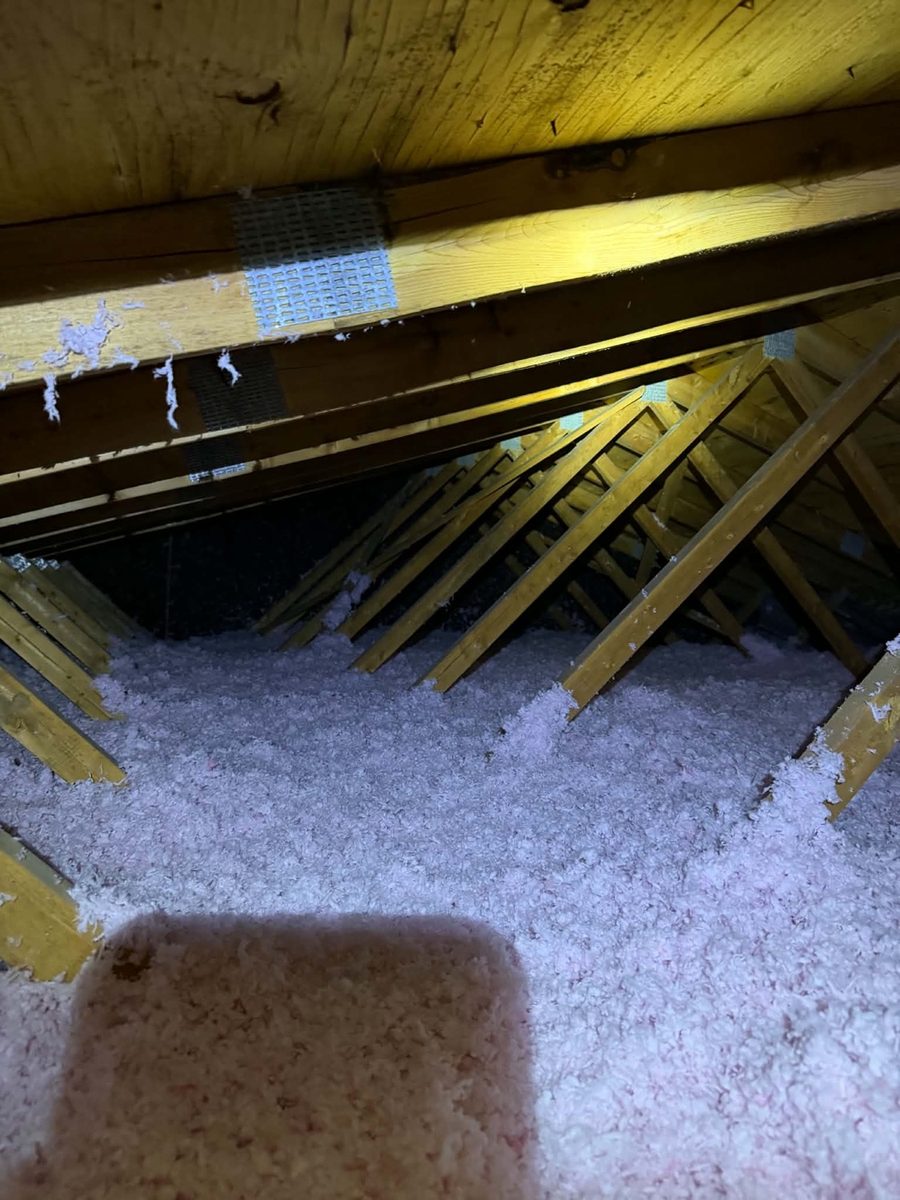
In practice, almost everyone aims higher than the minimum in the attic: Novoclimat requires about R-51 even in the south, LogisVert requires R-50 to subsidize the work. It's our target too, and our attic installations reach R-51. To see where your attic stands, measure it with our R-value calculator. The cost difference between R-41 and R-50 is small once the blowing machine is already on site. We explain which target to aim for in our guide on R-50 vs R-60 for the attic.
Am I required to bring my house up to code when renovating?
No. The Code is not retroactive. If your house was built according to the rules of its era, you are not required to upgrade it, not when selling, not when redoing the roof, not when changing windows. A 1985 house with an R-20 attic is perfectly legal.
There are two concrete exceptions:
- An addition or a new part of the building must meet current requirements, like new construction.
- Grants set their own targets. Hydro-Quebec's LogisVert pays up to $1,500 for work combining attic insulation and air sealing, but you must reach R-50. No R-50, no cheque. The details are in our guide on the LogisVert grant for 2026.
Nobody will force you to insulate. But if you do it, you might as well hit the target that gets you the money.
What is the difference between R and RSI?
They are the same measurement, thermal resistance, in two unit systems. RSI is the metric value (the one the Code uses), R is the imperial value (the one printed on insulation bags). The conversion: RSI × 5.678 = R. So RSI 7.22 gives R-41, and RSI 9.0 gives about R-51. When an official document speaks in RSI and your contractor speaks in R, nobody is contradicting anyone: they are saying the same thing in two languages.
What is Novoclimat?
Novoclimat is a voluntary Quebec government standard for new construction, more demanding than the Code. A Novoclimat-certified home uses about 20% less energy than a home built to the Part 11 minimum: higher insulation (about R-51 in the roof, even in the south), better tested airtightness, higher-performance ventilation. In exchange, the program offers financial assistance to the builder and the buyer.
Keep in mind: Novoclimat is for new builds. If you are renovating an existing home, it is not your program. LogisVert (or Rénoclimat) is the one that applies to you.
How thick does the insulation need to be to comply?
The R-value depends on the insulation used. Here are the approximate thicknesses of blown-in attic insulation needed to reach the Code minimum (R-41) and the grant target (R-50):
| Blown-in insulation | R per inch (approx.) | For R-41 | For R-50 |
|---|---|---|---|
| Cellulose | ~R-3.7/in | ~11-12 in | ~14-16 in |
| Blown fiberglass | ~R-2.6/in | ~16 in | ~19-20 in |
Beware of shortcuts: thickness alone guarantees nothing. Insulation that has settled, is unevenly spread or was blown over air leaks performs below its theoretical value. And each material has its own trade-offs. We compare them in detail in cellulose, blown fiberglass or spray foam.
Your house predates 2012? Here is what that means
The current requirements date from 2012. Before that, the minimums were much lower, and the further back you go, the thinner it gets. Most Quebec homes built before 2012 are below current attic standards, often around R-20 to R-30, sometimes less.
That is not illegal. But the gap between your attic and the standard is heat you pay for that escapes through the roof, winter after winter. And it is exactly the gap LogisVert pays to close: $1,500 to get to R-50 with air sealing. You are not required to do it, but you are paid to do it.
The first step is knowing where you stand and what the upgrade would cost. Our calculator gives you both, from your address.
Is your attic up to standard, or below it?
Enter your address: we estimate your current insulation, the price to reach R-50 and your grants, in 2 minutes.
Get my price →