


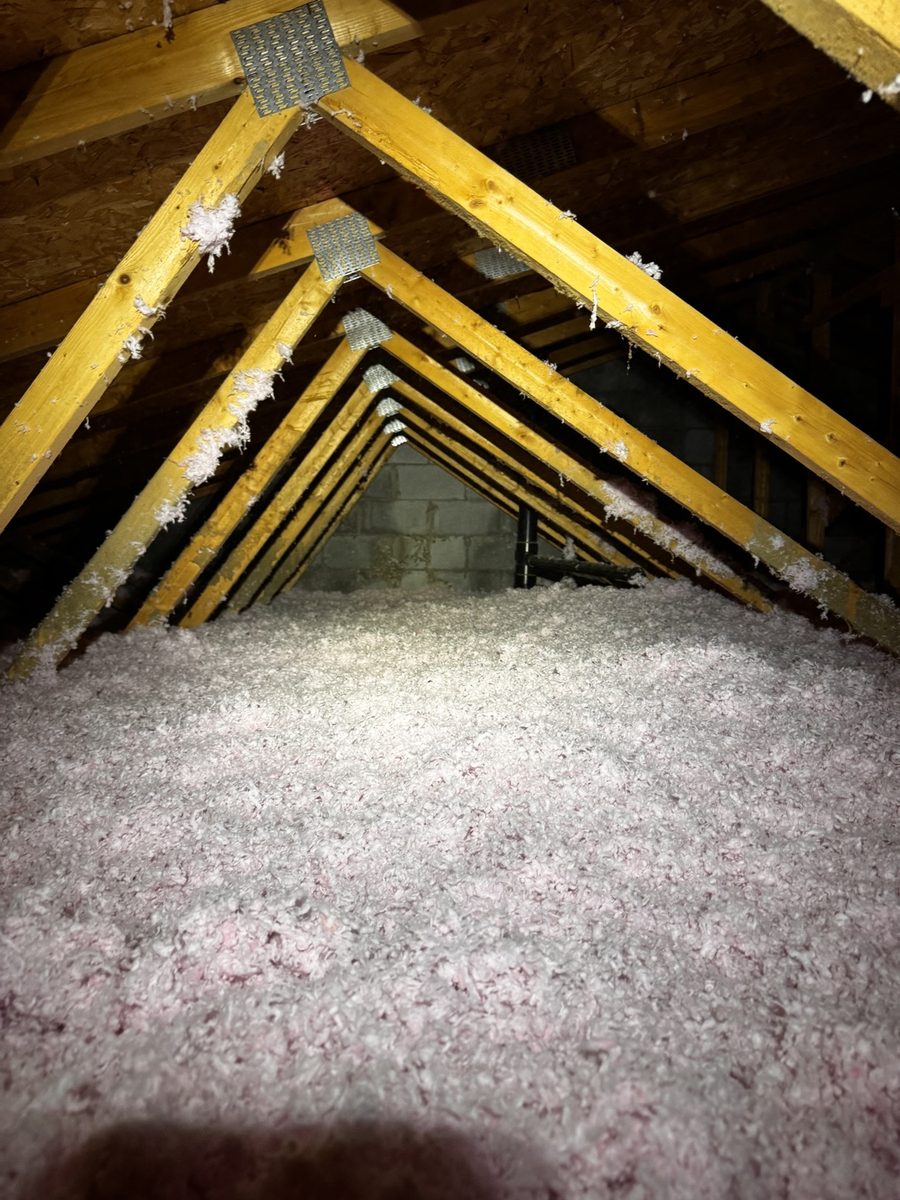
Frost under your roof is household moisture rising through the ceiling and freezing on the cold wood of the attic. A little after a cold snap is normal. A thick layer, nails gone completely white or wet insulation is not. You fix it by plugging the air leaks in the ceiling, sending the bathroom fan and range hood outside, then blowing fiberglass over the existing insulation, as long as it's dry.
The real trouble comes with the thaw. All that frost melts at once, soaks the insulation and sometimes ends up as a stain on the ceiling, with no hole anywhere in the roof. Here's how to tell normal from not normal, where the water comes from, what not to do, and what it costs to fix.
Is it normal to have frost in the attic?
A little, yes. Natural Resources Canada considers some frost buildup to be expected after a cold snap. Once the layer reaches 10 mm or more, you should check that the ventilation isn't blocked and look for where the moisture is coming from. Three frosty nails near the hatch and a white crust across the whole roof deck are not the same diagnosis at all.
Watch out for the classic trap: frost can form the second you open the hatch. Warm, humid house air rushes up into the cold attic and frosts whatever it touches. The Société d'habitation du Québec, the province's housing agency, flags this in its attic inspection checklist. Look quickly, and trust what was there before you showed up: the layer on the plywood, the water rings, the state of the insulation.
| What you find | What it means | How urgent? |
|---|---|---|
| A few frosty nails near the hatch or a light fixture | A localized air leak | Fix before next winter |
| Frost on most nails, whitened plywood | Humid house air is getting in all over | Deal with it this winter |
| A layer of 10 mm or more, ice on the insulation | Major leaks, ventilation probably blocked | Before the next thaw |
| Water rings, greyish wood, dark spots on the plywood | The frost and thaw cycle has been going on for several winters | Inspection, possible decontamination |
| Wet or flattened insulation, ceiling stain during a thaw | The water has already come down | Right away |
How do you check your attic in five minutes?
Pick a cold morning after two or three days below freezing. Grab a flashlight, climb a sturdy stepladder, open the hatch and stay on the ladder. You don't go walking around an attic: the joists are hidden under the insulation and the drywall ceiling won't hold your weight. From there, look at five things:
- The nail tips poking through under the roof. White with frost, or not?
- The plywood. Water rings, grey or black areas, especially near the bottom of the roof.
- The insulation. Grey or darkened patches in light-coloured insulation are the trace of an air current: Natural Resources Canada treats that discolouration as proof that air is getting through. Insulation that is crusted or slumped in patches has already taken on water.
- The ducts. A flexible bathroom fan duct that ends in the insulation instead of going outside is a frost machine.
- The soffits. According to the Société d'habitation du Québec checklist, the main sign that the soffits aren't blocked is seeing daylight along the edge of the roof.
If the insulation is granular rather than fluffy or batt-like, don't dig into it: it may be vermiculite, which can contain asbestos. Read our vermiculite guide first.
Where does all that water come from?
From inside. The roof has nothing to do with it. A lived-in house makes vapour every day: showers, cooking pots, laundry drying, everyone breathing. That vapour rises, and it finds its way into the attic through every unsealed hole in the ceiling. The routes we see most often:
- The attic hatch, a panel resting on its frame with no weatherstripping, often with no insulation on top;
- recessed pot lights, electrical wires, the plumbing stack and the gap around the chimney;
- the bathroom fan or range hood whose duct ends in the attic. Health Canada recommends making sure their air goes outdoors, never into the attic, and running the bathroom fan for at least 30 minutes after a shower;
- the dryer, poorly connected, pushing warm, moist air where it doesn't belong;
- an overly generous humidifier. Health Canada's guideline is to hold indoor humidity between 30% and 50%.
Here's what changes everything for your wallet: the air sealing required by Hydro-Québec's LogisVert targets exactly those spots. The list includes attic access hatches, range hoods and bathroom fans, along with windows, exterior doors, patio doors, electrical outlets and fireplaces. In other words, the grant pays to block the frost's highways.
Will adding roof vents fix the frost?
Not on their own. Vents remove moisture that has already made it up there; they don't stop it from getting in. Natural Resources Canada says so plainly, and also advises against electric attic fans, which can pull house air into the attic and make things worse. The right order: seal first, ventilate second.
Ventilation is still needed, though. Cold air has to come in at the soffits and leave at the top of the roof. If an old blow-in job buried the soffits, they get cleared and baffles keep an air channel between the insulation and the roof deck.
What should you definitely not do?
Don't blow new insulation over wet insulation, don't scrape a large area of mould yourself, don't block the soffits to "keep the heat in", and don't install an electric fan on the roof. Each of those reflexes makes the frost worse or hides the problem.
- Insulating over water. Natural Resources Canada says not to cover damp insulation until the moisture problem is solved and the insulation is dry again. A serious installer checks the condition of the existing insulation before blowing anything in.
- Playing decontamination expert. Once a single mouldy area goes past three square metres, Health Canada recommends calling in a qualified professional to assess and clean it up.
- Closing off the soffits. An attic with no air intake holds on to its moisture, and it ends up on the wood.
- Adding a turbine or electric fan. Without an airtight ceiling, you draw even more moist indoor air up into the attic.
How much does it cost to fix attic frost?
It depends on what you found up there. In most cases the insulation is dry, and the fix is air sealing the ceiling plus fiberglass blown over the top, at the price of a regular attic job. When the insulation has soaked up water or mould has set in, it has to come out first.
| Your situation | The fix |
|---|---|
| Light to moderate frost, dry and clean insulation | Air sealing the ceiling + fiberglass blown over the top up to R-51, at the price of a regular attic job |
| Bathroom fan or range hood duct ending in the attic | Extend it to an outside vent, before or while blowing the insulation |
| Wet or mouldy insulation, or widespread black stains | Insulation removal and decontamination, then new insulation. Market ranges are in our decontamination price guide |
A typical attic averages $2,495 on the market. With us, it comes to $1,995, air sealing included, then $495 after the $1,500 LogisVert grant if you qualify. Every price here is before taxes.
For the first case, there's no need to wait for a visit: enter your address in our online calculator and get your price in 2 minutes, estimated LogisVert grant included. An installer then confirms the measurements on site, before the work. If your attic needs to be emptied or cleaned up, our insulation removal and attic decontamination pages explain the steps.
When should you call someone?
As soon as the plywood is white with frost from end to end, it returns winter after winter, the insulation is wet or blackened, a ceiling gets stained during a thaw, or you can smell mould down in the house. And right away if you think you're looking at vermiculite.
The same attic that frosts up in winter often builds icicles along the roof edge: both come from the same air leaks. If you have both, also read our ice dam guide. One fix takes care of the two.
Frequently asked questions
Can attic frost drip through the ceiling in spring?
Yes. As long as it's cold, the frost stays put on the wood. At the first big thaw, it melts all at once, the water drops into the insulation and can work its way through to the ceiling. That's why some people see a stain appear in March even though their roof is in perfect shape.
Can fiberglass be blown over insulation that has had frost on it?
Yes, if it's dry and has kept its depth. Natural Resources Canada says dry insulation can usually stay in place. If it's still damp, you fix the source first and wait for it to dry. If it's mouldy or soiled, it comes out.
Should I turn off my humidifier?
Not necessarily. Health Canada's target is 30% to 50% humidity in the house. A small hygrometer tells you where you stand. Above 50%, you're sending more vapour toward the attic than you need to.
Does LogisVert pay to fix attic frost?
Indirectly. The $1,500 grant funds roof insulation up to R-50 and air sealing, for homes heated mostly with electricity. That air sealing blocks the frost's routes. Details in our LogisVert 2026 guide.
Is the work guaranteed?
Blown-in fiberglass work is guaranteed for life, under our terms (in French). Decontamination and insulation removal work is guaranteed for 2 years.
Official sources
- Keeping the Heat In (NRCan), section 5.1 on assessing the attic, PDF
- Attic inspection checklist, sloped roof (Société d'habitation du Québec), PDF in French
- Health Canada's moisture and mould guide
- LogisVert program (Hydro-Québec), list of items to air seal
Checked on October 31, 2026.
Frost up there? See what the fix costs
Enter your address, answer a few questions, and get your price in 2 minutes, no visit needed. LogisVert grant calculated automatically.
Get my price →